Openbyte
Get in Touch →

info@openbyte.co.za
0860 222 111

STABLE • OPEN SOURCE • ICT SOLUTIONS

Linux Forensics &
Incident Response

When a Linux server is compromised, the difference between a quick recovery and a prolonged outage comes down to how the incident is investigated.

Linux Digital Forensics & Incident Response

The difference between a quick recovery and a prolonged outage often comes down to how the incident is investigated - not just how fast it's remediated.

Openbyte provides Linux digital forensics and incident response (DFIR) services for South African businesses running Linux infrastructure in Johannesburg, Cape Town, and beyond - helping you understand what happened, contain the damage, preserve evidence, and prevent it from happening again.

With more than 20 years of Linux systems experience and open-source security tooling already deployed across our managed environments - including Wazuh SIEM - we're positioned to move from detection straight into investigation without the delay of onboarding an unfamiliar stack.
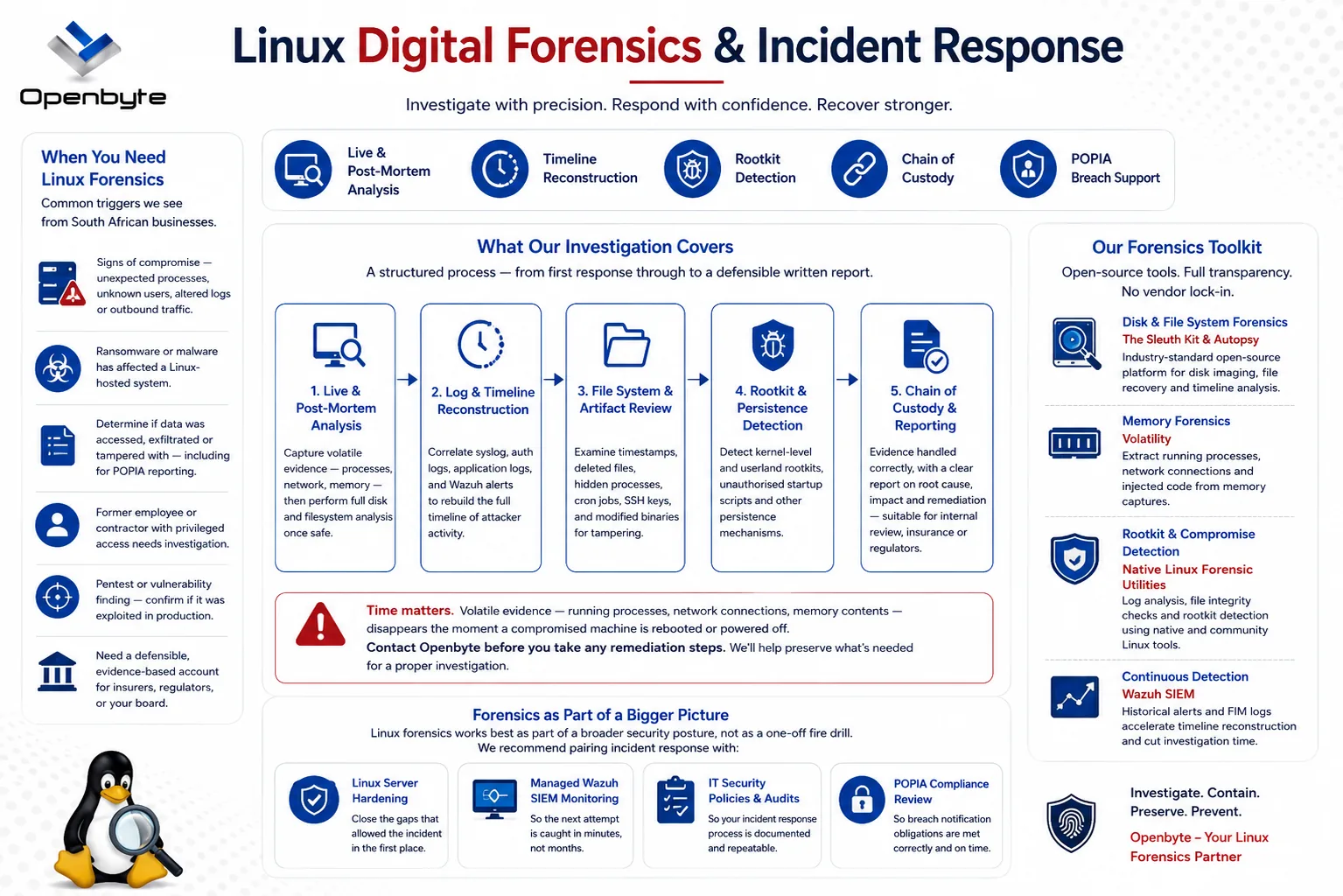
Live & Post-Mortem Analysis Timeline Reconstruction Rootkit Detection Chain of Custody POPIA Breach Support
Linux Forensics and Incident Response Process

Click to expand - Linux incident response process

Time matters. Volatile evidence - running processes, network connections, memory contents - disappears the moment a compromised machine is rebooted or powered off. Contact Openbyte before you take any remediation steps, so we can help preserve what's needed for a proper investigation.

When You Need Linux Forensics

Common triggers we see from South African businesses running Linux infrastructure.

A server shows signs of compromise - unexpected processes, unfamiliar user accounts, altered logs, or outbound traffic to unknown hosts.

Ransomware or malware has affected a Linux-hosted system.

You need to determine whether data was accessed, exfiltrated, or tampered with - including for POPIA breach assessment and reporting obligations.

A former employee or contractor with privileged access needs to be investigated.

You've received a pentest or vulnerability finding and need to confirm whether it was ever exploited in production.

You need a defensible, evidence-based account of an incident for insurers, regulators, or your own board.

What Our Investigation Covers

A structured investigation process - from first response through to a defensible written report.

Live & Post-Mortem Analysis

Capturing volatile data - running processes, network connections, memory - before a compromised system is powered down, followed by full disk and filesystem analysis once it's safe to do so.

Log & Timeline Reconstruction

Correlating syslog, auth logs, application logs, and Wazuh alert data to build an accurate timeline of attacker activity: initial access, privilege escalation, lateral movement, and persistence.

File System & Artifact Review

Examining file timestamps, deleted files, hidden processes, cron jobs, SSH keys, and modified system binaries for signs of tampering or backdoors.

Rootkit & Persistence Detection

Checking for kernel-level and userland rootkits, unauthorised startup scripts, and other mechanisms attackers use to maintain access.

Chain of Custody & Reporting

Evidence handling that stands up to scrutiny, with a clear written report covering root cause, scope of impact, and remediation steps - suitable for internal review, cyber insurance claims, or regulatory submission.

Built on Open-Source Tooling

No vendor lock-in and full transparency into methodology - no black-box tooling standing between you and your own evidence.

Our Forensics Toolkit

In keeping with our open-source philosophy, our forensic work draws on established, industry-standard tools - layered with the visibility we already maintain through Wazuh SIEM for clients on our managed security service. This means no vendor lock-in, full transparency into methodology, and no black-box tooling standing between you and your own evidence.

Disk & file system forensics

The Sleuth Kit & Autopsy

Industry-standard open-source forensic platform for disk imaging, file recovery, and timeline analysis - with a graphical interface suitable for detailed evidentiary review.

Memory forensics

Volatility

The leading open-source memory forensics framework, used to extract running processes, network connections, and injected code from a memory capture taken before a system is powered down.

Rootkit & compromise detection

Native Linux Forensic Utilities

Native and community Linux utilities for log analysis, file integrity checks, and rootkit detection - validating findings against the host's own tooling, not just third-party scanners.

Continuous detection

Wazuh SIEM

Where Wazuh is already deployed, historical alert data and file integrity monitoring logs accelerate timeline reconstruction significantly, cutting investigation time.

Forensics as Part of a Bigger Picture

Linux forensics works best as part of a broader security posture, not as a one-off fire drill. We recommend pairing incident response with:

Frequently Asked Questions

Common questions about Linux forensics and incident response from South African businesses.
Our Linux server looks compromised - what should we do first?
Do not reboot or power off the machine, and avoid running remediation steps yourself. Volatile evidence - running processes, network connections, memory contents - disappears the moment a compromised system is restarted. Contact Openbyte immediately so we can capture live data before anything is lost.
Can you help determine if data was accessed or exfiltrated?
Yes. We reconstruct timelines from logs, filesystem artifacts, and network activity to determine whether data was accessed, copied, or tampered with - output that's suitable for POPIA breach assessment and reporting obligations to the Information Regulator.
Do we need to already have Wazuh SIEM deployed for you to investigate?
No - we can investigate any Linux environment, with or without existing security tooling. However, if Wazuh is already deployed, historical alert data and file integrity monitoring logs speed up timeline reconstruction significantly.
Will your report hold up for insurance or regulatory purposes?
Yes. We follow proper evidence handling and chain-of-custody practices throughout the investigation, and deliver a written report covering root cause, scope of impact, and remediation steps - suitable for internal review, cyber insurance claims, or regulatory submission.
What tools do you use for Linux forensics?
In line with our open-source philosophy, we use established tools such as The Sleuth Kit, Autopsy, and Volatility, alongside native Linux forensic utilities and Wazuh SIEM data where available. This means no vendor lock-in and full transparency into our methodology.
Can you investigate a former employee's access after they've left?
Yes. We regularly investigate privileged-access misuse by former employees or contractors - reviewing authentication logs, file access history, and system changes to build a factual, defensible account of what occurred.
Linux Docker GCP Ubuntu Nextcloud Wazuh BareOS Zabbix OPNsense Claude Linux Docker GCP Ubuntu Nextcloud Wazuh BareOS Zabbix OPNsense Claude