
info@openbyte.co.za
0860 222 111
We design, deploy, and automate cloud infrastructure that's consistent, scalable, and repeatable.
We design, deploy, and automate cloud infrastructure across public cloud platforms, private cloud environments, and on-premises virtualisation - keeping everything consistent, scalable, and repeatable. We help Johannesburg and Cape Town businesses select the right platform for their workload and budget. Our Linux servers expertise means we can migrate your existing on-premises infrastructure to the cloud with minimal disruption. We also implement monitoring solutions to give you full visibility after migration.
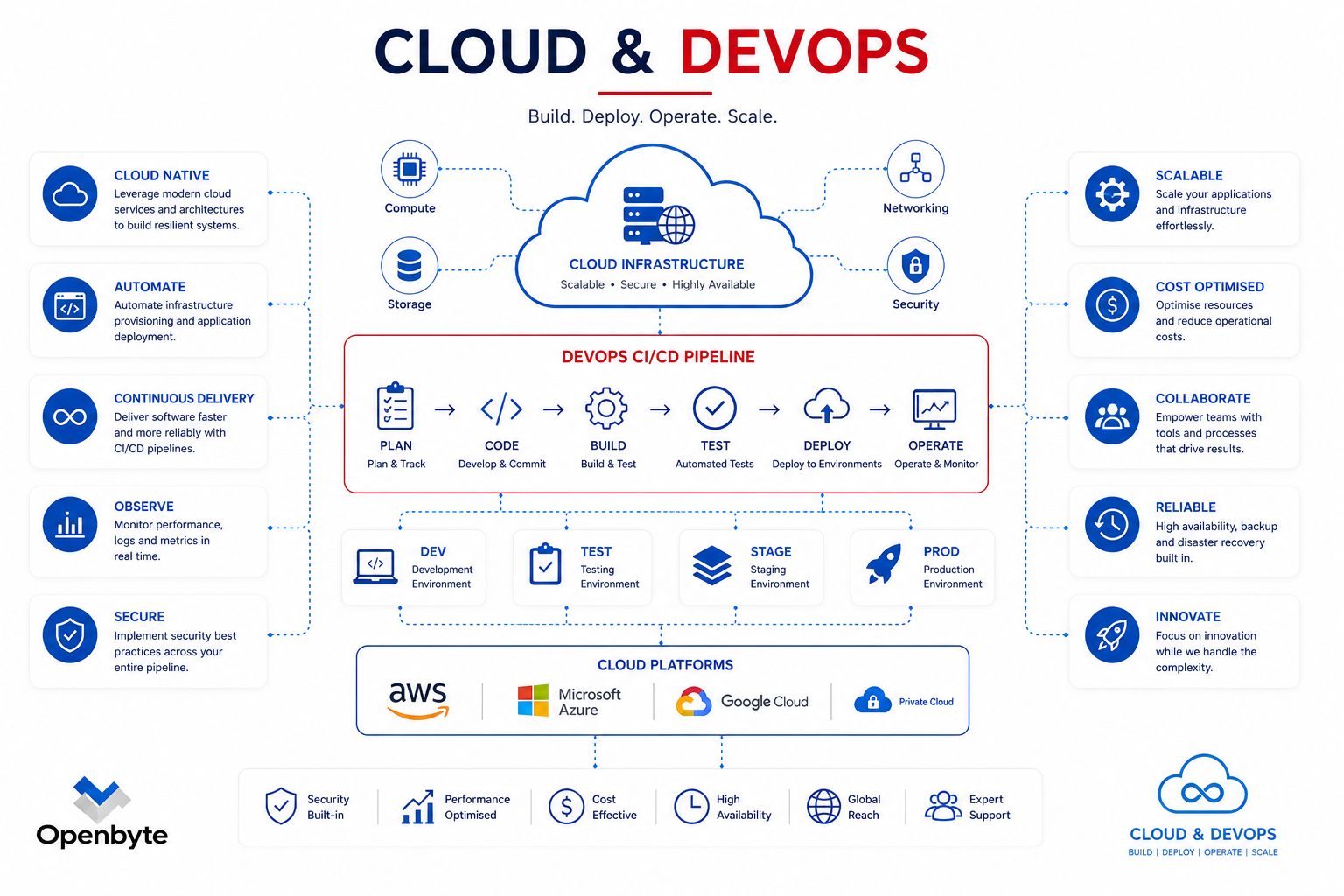
Click to expand - Cloud & DevOps architecture overview
We provision, migrate, and manage workloads across public cloud platforms - with particular expertise in Google Cloud Platform (GCP). Whether you're starting fresh or moving existing workloads, we handle the full lifecycle.
Scalable virtual machines and managed compute services across GCP and other public cloud providers.
Container orchestration using Kubernetes - including Google Kubernetes Engine and self-managed clusters.
Event-driven and fully managed compute - deploy applications without provisioning or managing servers.
Software-defined networking with private subnets, firewall rules, VPC peering, and inter-region connectivity.
Global and regional load balancing with autoscaling - external and internal, for high availability workloads.
Managed authoritative DNS and content delivery networks for fast, resilient global access to your services.
Object, block, and file storage with encryption at rest, lifecycle policies, and snapshot management.
End-to-end migration planning and execution - from on-premises or legacy hosting to public or private cloud.
Not everything belongs in the public cloud. We design and manage private cloud environments using open-source hypervisors - giving you cloud-like flexibility on your own hardware.
Full Proxmox Virtual Environment setup - nodes, clusters, storage pools, HA, and web-based management for VMs and LXC containers.
Kernel-based Virtual Machine deployments on Linux - performant, open-source virtualisation with libvirt and virt-manager management.
High-availability Proxmox clusters with shared storage (Ceph, NFS, iSCSI) and automatic VM failover across nodes.
Connect private Proxmox/KVM environments to public cloud platforms via VPN or dedicated links for a true hybrid architecture.
Automated VM backups, snapshot scheduling, and off-site replication using Proxmox Backup Server and open-source tooling.
Standardised VM templates and cloud-init images for fast, repeatable provisioning across your private cloud environment.
Once your cloud is running - public or private - Ansible keeps every environment consistent, eliminating manual configuration drift at any scale.
Ansible is an open-source automation platform for provisioning, configuration management, and application deployment. It works over SSH with no agent software required on target machines - public cloud VMs, Proxmox guests, or bare-metal servers alike.
With over 1,300 built-in modules and integrations for GCP and other cloud providers, Ansible lets us define your entire infrastructure configuration as code and apply it reliably across dev, staging, and production environments.
We write and maintain Ansible Playbooks - human-readable YAML files that describe exactly how your infrastructure should be configured - and version-control them alongside your application code. We implement CI/CD pipelines using tools like GitLab CI, Jenkins, and GitHub Actions, integrating with containerised environments using Docker and Kubernetes.
We use Ansible to automate:
Communicates over standard SSH - no client software to install or maintain on your servers.
Run playbooks repeatedly without side effects. Systems always converge to the desired state.
Manage public cloud VMs, Proxmox guests, KVM hosts, and bare-metal servers from the same control node.
Native modules for GCP and other major providers - provision resources directly from playbooks.
Thousands of community-built and vendor-certified roles for rapid, proven automation at your fingertips.
Infrastructure As Code, or IaC, means your entire environment - servers, networks, firewall rules, storage - is defined in version-controlled files. No more manual clicks in a console, no more undocumented changes.
The open-source, community-governed fork of Terraform under the Linux Foundation. Declarative HCL files provision and manage resources across GCP, private cloud, and other providers - state tracked remotely, changes planned before applied.
Define infrastructure using real programming languages - Python, TypeScript, or Go. Ideal for teams who want the full power of a language (loops, functions, testing) applied to infrastructure rather than a custom DSL.
Beyond configuration management, Ansible provisions cloud and on-premises resources directly from playbooks - bridging public cloud, Proxmox, and KVM environments in a single agentless toolchain.
When infrastructure is code, spinning up a new environment takes minutes, not days, rollbacks are trivial, and every change has a paper trail. Infrastructure can be peer-reviewed, tested, and deployed through the same pipeline as your application - whether it targets GCP, Proxmox, or both.
Common questions about Cloud and DevOps services from South African businesses.